ECC vs Non-ECC Memory: What Servers Actually Need

ECC memory costs more than standard memory, requires a platform that supports it, and prevents a class of failure most people never knowingly experience. Whether that is worth paying for depends entirely on what the machine does.
This guide covers what ECC actually protects against, why servers use it universally, and where it is genuinely unnecessary.
The problem ECC solves
Memory stores data as electrical charge in tiny cells. That charge can be disturbed — by electrical interference, by background radiation, by manufacturing marginality, by heat, by a cell that is beginning to degrade.
When a bit flips, the data in memory no longer matches what was written. Nothing announces this. The system carries on using the corrupted value.
What happens next is unpredictable and that is the point. It might be a pixel in an image nobody notices. It might be a number in a spreadsheet that is now silently wrong. It might be a pointer in a running process, producing a crash with no obvious cause. It might be a value written to a database, which then gets backed up faithfully in its corrupted state.
The last one is the reason enterprises care. A crash is visible and recoverable. Silent corruption written to storage is neither.
How ECC works
ECC stands for error-correcting code. Alongside each block of data, the module stores additional bits calculated from that data.
When the data is read back, the check is recalculated and compared. If they disagree, an error has occurred somewhere.
Standard ECC can correct a single-bit error transparently — the correct value is reconstructed and passed on, and the system logs the event without interruption. It can detect a two-bit error but not correct it, in which case the system halts rather than continuing with data it knows is wrong.
That last behaviour is deliberate and worth understanding. A server that halts on an uncorrectable memory error is doing the right thing. Continuing would mean writing known-bad data.
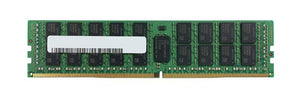
The extra bits are why ECC modules carry more memory chips than their non-ECC equivalents, and part of why they cost more.
Why every server uses it
Three reasons compound.
Uptime. A single-bit error on a non-ECC system may crash the machine. On an ECC system it is corrected and logged, and nothing happens. Across a fleet running continuously, that difference is measurable.
Data integrity. Servers write to databases, file systems and storage arrays. Corruption in memory propagates into all of them, and backups preserve it faithfully. There is no recovery path once bad data has been committed and replicated.
Warning. ECC logs correctable errors. A module producing an increasing number of corrected errors is failing, and that log gives you the chance to replace it during a maintenance window rather than after a crash. Without ECC you get no warning at all — the first sign is the failure itself.
That third point is underrated. ECC is not only correction, it is monitoring.
Where ECC is genuinely unnecessary
An honest treatment has to include this.
On a desktop used for browsing, office work and general computing, a rare bit flip most likely produces nothing you would notice, or at worst an application crash you shrug off and reopen. The cost of ECC and an ECC-capable platform is not justified by that.
Gaming systems are the same case. A flipped bit in a texture is invisible.
The line falls where silent corruption would be expensive. Workstations doing financial modelling, scientific computation, video rendering to archive, CAD, or anything where the output is trusted and stored are closer to servers than to desktops in this respect, and many professional workstations support ECC for exactly that reason.
Registered, unbuffered and load-reduced
ECC is frequently confused with the register type, and they are separate specifications that usually travel together.
ECC is about error correction.
Registered, unbuffered or load-reduced is about how the module presents electrically to the memory controller, which determines how many modules a system can address reliably.
You can have ECC unbuffered memory, and you can have non-ECC unbuffered memory. What you generally cannot do is mix them, or fit the wrong register type — the platform expects one and will not work with another. Our RDIMM, UDIMM and LRDIMM guide covers that distinction in detail.
Compatibility rules
Four rules that decide whether memory will work, and none are negotiable.
The platform must support ECC. Both the processor and the motherboard have to. Fitting ECC memory to a system that does not support it typically results in it running as standard memory with the correction unused — or not posting at all.
Do not mix ECC and non-ECC. Most systems will not run the combination. Where they do, ECC is generally disabled entirely, so you have paid for it and lost it.
Register type must match. Registered, unbuffered and load-reduced modules are not interchangeable within a system.
Generation must match. DDR3, DDR4 and DDR5 are physically keyed differently and cannot be forced. Speed and capacity have some flexibility; generation has none.
The reliable approach on any existing server is the same one that applies to drives: read the part number off a module currently fitted and match against it. Working from the server model alone misses configuration differences.
What advanced ECC adds
Server platforms often implement protection beyond standard single-bit correction, under vendor-specific names.
These schemes can survive the failure of an entire memory chip on a module rather than just a bit, by spreading data and check bits so that a whole device failing is recoverable. Some also allow a failing region to be mapped out, or a spare rank to take over automatically.
The practical relevance: these features usually require specific module types and population arrangements to work. If your platform documentation specifies them, populating memory incorrectly can silently disable protection you believe you have. Check the population rules rather than assuming any valid configuration is equivalent.
Refurbished memory and testing
Memory is unusual among components in that it either works correctly or fails in ways that are detectable by testing. There is no meaningful wear-out mechanism comparable to a mechanical drive — no moving parts, no accumulated hours degrading a bearing.
That makes tested refurbished memory a reasonable proposition for server use, and it is why the market for it is substantial. What matters is that it has actually been tested rather than pulled and resold, and that the part number matches your platform exactly.
Our refurbished process page explains our condition labelling and testing, and everything we supply carries a 30-day warranty with 30-day returns and a 25% restocking fee, waived for defective or wrongly shipped items.
Sourcing
We source server memory to order against exact part numbers. Send us the part number from a module currently fitted, or your server model and generation, along with the configuration you need, and we will confirm compatibility before quoting.
The bulk quote page explains what to include for the fastest turnaround, or email sarah.jane@techsellerusa.com.
Common questions
What does ECC memory actually do?
It stores additional check bits alongside the data. On read, the check is recalculated: a single-bit error is corrected transparently and logged, while a two-bit error is detected and the system halts rather than continuing with data it knows is wrong.
Why do servers always use ECC?
Uptime, data integrity and warning. A corrected error causes no interruption where a non-ECC system might crash; corruption in memory otherwise propagates into databases and backups with no recovery path; and logged correctable errors let you replace a failing module before it fails outright.
Do I need ECC in a desktop or gaming PC?
Generally not. A rare bit flip in browsing or gaming produces nothing you would notice, or at worst a crash you reopen from. The line falls where silent corruption would be expensive — financial modelling, scientific computation, CAD and rendering are closer to servers in this respect.
Can I mix ECC and non-ECC memory?
Most systems will not run the combination at all. Where they do, ECC is generally disabled entirely — so you have paid for the protection and lost it. Keep the system uniform.
Is ECC the same as registered memory?
No, they are separate specifications that often travel together. ECC is about error correction; registered, unbuffered and load-reduced describe how the module presents electrically to the memory controller, which affects how many modules a system can address.
Is refurbished server memory a sensible buy?
Memory either works correctly or fails in ways testing detects, and it has no wear-out mechanism comparable to a mechanical drive. Tested refurbished memory is a reasonable proposition provided it has genuinely been tested and the part number matches your platform exactly.
Send us the part number from a fitted module or your server model and we will confirm compatibility before quoting.