Linerless Labels Explained: What They Save and Where They Fail

Every conventional label roll carries a second layer that gets thrown away. The liner — the silicone-coated backing the labels peel off — is roughly as thick as the label itself, occupies about half the roll, and ends up in the bin.
Linerless media removes it. That changes how much label fits on a roll, how often the roll is changed, and what happens to the waste. It also requires a printer built for it, which is the part that decides whether the idea is practical for a given site.
How linerless media works
The construction problem is obvious once stated: if the adhesive is on the back and there is no liner, what stops the roll sticking to itself?
The answer is a release coating on the printable face. The silicone that would normally be on the liner is applied to the top surface of the label instead, so as the roll winds, the adhesive on the underside of each wrap sits against the released face of the wrap below and separates cleanly.
That single change carries consequences through the whole system. There is no liner to peel and discard, no die-cut gaps between labels, and no fixed label length — the media is a continuous strip, and length is decided at the moment of printing.
What you gain
Four things, and their relative weight depends heavily on the operation.
Substantially more label per roll. Removing a layer of roughly the same thickness as the label means a roll of a given diameter holds considerably more usable media. On high-volume lines that is the headline benefit.
Fewer roll changes. Directly downstream of the above. In a dispatch operation running continuously, roll changes are dead time and an interruption point, and reducing them has an operational value beyond the media cost.
No liner waste. Liner is silicone-coated and generally not accepted in standard paper recycling, so it goes to landfill or to a specialist stream. Removing it removes both the disposal cost and the handling. For operations with waste reduction targets this is frequently the reason the conversation starts.
Variable label length. Because the media is continuous and cut to length, one roll can produce a short price label and a long shipping label without changing stock. Operations that currently hold several die-cut sizes can sometimes consolidate to one.
The printer requirement
This is the constraint that decides most of it, and it is not negotiable.
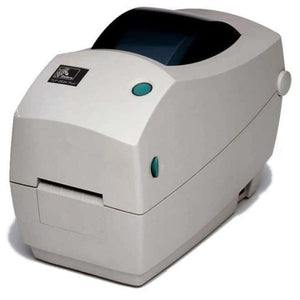
Linerless media cannot go into a standard label printer. In a conventional printer the label's adhesive never touches anything except its own liner. With linerless, exposed adhesive passes directly over the platen roller and through the media path.
A linerless-capable printer differs in three specific ways.
A non-stick platen. The roller is treated so adhesive does not build up on it. A standard rubber platen fouls quickly and then drags, jams or transfers adhesive onto subsequent labels.
A cutter, and a specific type of it. With no die-cut gaps, the only way to separate one label from the next is to cut. Linerless cutters use a coated or heated blade design intended to shed adhesive, since a standard blade gums up.
A treated media path. Guides, rollers and tear bars in contact with the adhesive face need the same non-stick treatment.
Some manufacturers offer conversion kits for particular models. Where they exist they are model-specific parts with their own part numbers, and they are the exception rather than the norm — most linerless deployment means a linerless printer.
One further configuration point. With no gaps between labels the printer cannot use a transmissive gap sensor to find label boundaries, so linerless runs in continuous mode or against black marks. That is a media handling setting rather than a hardware issue, and our guide to printer media handling modes covers the distinction.
Where linerless is the wrong choice
Three limitations that rule it out for a large share of labelling work.
Direct thermal in almost all cases. The release coating on the face conflicts with thermal transfer ribbon adhesion, so linerless media is overwhelmingly direct thermal. That inherits every direct thermal limitation — the print fades with heat, light and time, and it is unsuitable for anything needing a long readable life or exposure to sun or heat. Our media and ribbon guide covers where that line sits.
A narrower range of adhesives and facestocks. Conventional liner-based media is available in freezer-grade adhesives, removable adhesives, synthetic facestocks for chemical or outdoor exposure, and tamper-evident constructions. Linerless offerings are a fraction of that. If the application needs a specialty adhesive, linerless probably does not have it.
Higher maintenance sensitivity. Adhesive is in contact with the platen, cutter and path by design, so cleaning is not optional. A site that already struggles to clean printheads on schedule will struggle more with linerless. Our printer maintenance guide covers the routine.
Where it fits well
The pattern across successful deployments is short label life, high volume, and simple application to a clean surface.
Dispatch and parcel labelling where the label is read by a carrier within days and discarded. High volume, roll changes are costly interruptions, and liner waste accumulates visibly.
Food service and date labelling where labels are applied to packaging or containers and discarded within days, and where variable length suits different product descriptions on one roll.
Retail scale and counter labelling with continuous printing, short label life and value in eliminating the liner from a customer-facing area.
Queue, order and collection labelling in hospitality and takeaway, where labels live for minutes.
Where labels need to survive a warehouse rack for three years, an outdoor asset for a season or a freezer for months, conventional media with a matched adhesive and a thermal transfer ribbon remains the right answer.
Working out whether it pays
Media cost per roll is the wrong comparison, because rolls do not hold the same number of labels.
The comparison that means something is cost per label, plus the operational items linerless removes. Roll change frequency and the labour attached to it. Liner disposal cost, including any specialist waste stream. Stock consolidation if variable length replaces several die-cut sizes. And the capital cost of linerless-capable printers where the existing fleet cannot take the media.
The last of those usually decides it. On a site already replacing printers, adding linerless capability is a specification choice at modest incremental cost. On a site with a working fleet that cannot run linerless, the media saving has to fund new hardware before it funds anything else, which typically only works at high volume.
Sourcing
We supply label printers across Zebra, SATO, Bixolon and Epson ranges, including linerless-capable models, with the exact manufacturer part number and configuration stated on every line.
Tell us the volume, what the labels go on and how long they need to last, and we will tell you whether linerless is worth specifying or whether conventional media serves the application better. Send a bill of materials through the bulk quote page or email sarah.jane@techsellerusa.com.
Common questions
What are linerless labels?
Label media with no backing liner. The silicone release coating that would normally be on the liner is applied to the printable face instead, so the adhesive on each wrap separates cleanly from the face of the wrap below as the roll unwinds.
Can I run linerless labels in my existing printer?
Only if it is linerless-capable. Exposed adhesive passes directly over the platen and through the media path, so the printer needs a non-stick platen, an adhesive-shedding cutter and a treated path. A standard printer fouls quickly and then drags, jams or transfers adhesive onto labels.
How many more labels does a linerless roll hold?
Substantially more at the same roll diameter, because the liner removed is roughly as thick as the label itself. The exact figure depends on the media construction and roll specification, so compare cost per label rather than cost per roll.
Is linerless available as thermal transfer?
Rarely. The release coating on the printable face conflicts with ribbon adhesion, so linerless media is overwhelmingly direct thermal. That means it inherits direct thermal's limitations — print fades with heat, light and time — and is unsuitable for long-life or exposed applications.
Can linerless labels be any length?
Within the printer's limits, yes. The media is a continuous strip cut at print time rather than die-cut to a fixed size, so one roll can produce short and long labels. Operations holding several die-cut sizes can sometimes consolidate to one stock item.
Does linerless need more maintenance?
Yes. Adhesive contacts the platen, cutter and media path by design, so cleaning on schedule is required rather than advisable. A site that already struggles to clean printheads regularly will find linerless less forgiving.
Tell us the volume and how long the labels need to last and we will tell you whether linerless is worth it.